What Is the Dress Code for a Garden Wedding?
Short answer: A garden wedding sits between formal and casual: the setting says relaxed, the occasion says celebrate, and your outfit has to honor both. Expect to need breathable fabrics, shoes that grip grass, and silhouettes that move with a breeze, then check the invitation for wording like garden formal, semi-formal, or cocktail garden.
Garden weddings sit in a sweet spot between formal and casual. The setting says relaxed, but the occasion says celebrate — and your outfit needs to honor both. Unlike a hotel ballroom, a garden demands fabrics that breathe, shoes that grip grass, and silhouettes that move with a breeze rather than fight it. The unspoken rule is: look polished, but never look like you are suffering.
Before you buy anything, check the invitation. Words like “garden formal,” “semi-formal,” or “cocktail garden” each shift the dial. If you see no dress code at all, aim for the middle — elegant but not overdressed. Our guide below covers every angle so you arrive confident and comfortable.
Which Colors Work Best for a Garden Wedding?
Short answer: Earthy tones harmonize best: terracotta, dusty rose, sage, and warm beige all sit comfortably against green foliage, and floral prints echo the setting without looking redundant. Avoid stark white, which belongs to the bride, and heavy black, which reads too dark in sunlight.
A garden is already a tapestry of green, so your outfit should complement, not compete. Earthy tones — terracotta, dusty rose, sage, warm beige — harmonize with foliage. Floral prints echo the surroundings without feeling redundant. Avoid stark white (the bride’s territory) and jet black (too heavy for sunlight). Pastels read beautifully in natural light, but choose muted rather than neon versions.
The color strategy also depends on the season. A spring garden wedding calls for lighter, fresher tones — soft lavender, pale peach, mint green. A summer garden allows richer warmth — terracotta, mustard, deep olive. An autumn garden pairs best with burgundy, copper, and chocolate brown. Match your color to the garden’s own palette at that time of year.
Which Color Strategies Should You Choose?
Short answer: Play it safe with dusty rose, champagne, or soft lavender; go bolder with terracotta, deep mustard, or rich olive; or lean on a floral print over a neutral base. Skip pure white, neon, and heavy black. The season decides too: lighter tones for spring, richer warmth for summer, burgundy and copper for autumn.
- Safe bet: Dusty rose, champagne, soft lavender
- Bolder choice: Terracotta, deep mustard, rich olive
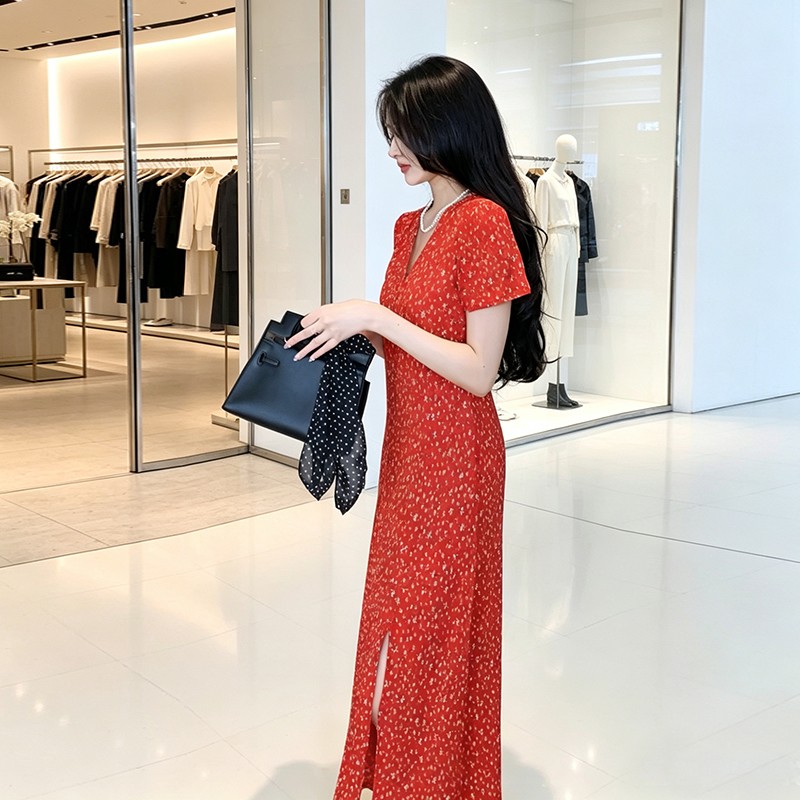
- Print approach: Floral on a neutral base — see our floral V-neck midi dress with side slit
- What to skip: Pure white, neon, heavy black
What Are the Best Dresses for a Garden Wedding?
Short answer: Midi and maxi lengths are the safest picks because they keep hemlines clear of damp grass while still looking event-appropriate, and a side slit adds movement so the skirt does not cling when humidity rises. Wide-leg pants and two-piece sets are equally wedding-worthy alternatives.
Midi and maxi lengths are your best friends. They keep hemlines clear of damp grass while looking event-appropriate. A side slit adds movement and prevents the skirt from clinging when humidity rises. Our floral V-neck midi dress was designed with exactly this scenario in mind — breathable fabric, a slit that walks easily, and a print that belongs in a garden.
If dresses are not your preference, wide-leg pants create a formal impression with far more freedom. Pair high-waist wide-leg palazzo pants with a tucked silk blouse and you have an outfit that is every bit as wedding-worthy as any dress. The high waist elongates your silhouette, and the wide leg moves beautifully when you walk across a lawn — no clinging, no restricting, no awkward tugging at a pencil skirt hem.
For the most adaptable option, consider a two-piece set. The resort linen two-piece set gives you a matching top and bottom that look coordinated and intentional, but you can also remove the jacket layer as the day warms up. The linen fabric breathes naturally and resists wrinkling better than pure linen, making it ideal for the garden’s humidity and long photo sessions.
What Shoes Should You Wear to a Garden Wedding?
Short answer: Choose footwear with a broad base, because stilettos sink into grass and it is physics rather than aesthetics. Block heels under 3 inches, espadrille wedges, and embellished flats all stay upright, and you should always carry a flat backup for the lawn reception.
Stilettos sink. Block heels, wedges, and flat sandals stay upright. This is not aesthetics; it is physics. Choose footwear with a broad base — block heels under 3 inches, espadrille wedges, or embellished flats. If the ceremony is on a paved patio, you can go slightly higher, but always carry a flat backup for the lawn reception.
Consider the ground surface carefully. A manicured lawn with short grass can tolerate a narrow heel better than a wild garden with longer grass and soft soil. Gravel paths are fine for most heels, but sand or bark chip surfaces require flats or wedges exclusively. When in doubt, err toward the broader base — you will spend the entire day on your feet, and comfort is not optional.
What Should Be on Your Garden Wedding Shoe Checklist?
Short answer: Block heels for polish and stability, wedges as the most grass-friendly elevated option, decorated flats for zero sink risk, and a backup pair in your bag for surface transitions. Leave stilettos, thin heels, and pointed spike bases at home. Gravel is fine for most heels; sand and bark chip need flats.
- Block heels — polished and stable
- Wedges — the most grass-friendly elevated option
- Decorated flats — zero sink risk, still festive
- A backup pair in your bag for surface transitions
- Avoid stilettos, thin heels, and anything with a pointed spike base
Which Accessories Work Best at a Garden Wedding?
Short answer: Plan accessories that adapt rather than restrict. A wide-brim hat shields you during the ceremony and doubles as a photo prop, a light pashmina covers bare shoulders after sunset, and a medium leather crossbody carries sunscreen, a flat backup, and a small umbrella without losing polish.
A garden wedding moves you between sun, shade, and possibly a light drizzle. Plan accessories that adapt rather than restrict. A wide-brim hat shields you during the ceremony and becomes a styling prop for photos. A light pashmina or wrap covers bare shoulders if the temperature drops after sunset. Keep jewelry simple — one statement piece, not five competing ones.
Your bag choice matters more than you might expect. A structured small bag or clutch keeps your look formal, but it cannot hold the practical items a garden wedding demands: sunscreen, a flat shoe backup, and a small umbrella. Consider a medium leather crossbody that looks polished but carries essentials, or stash a small pouch inside a more formal clutch and transfer to the crossbody for the reception.
How Do You Plan for Weather at an Outdoor Wedding?
Short answer: Check the forecast 48 hours ahead and pack for the most likely condition. A removable layer handles a warm afternoon and a cool evening in one outfit, quick-dry fabrics and a waterproof flat backup cover rain, and for wind you should avoid very flowy skirts that catch air.
Outdoor events mean weather is a variable you cannot ignore. Check the forecast 48 hours ahead and pack accordingly. If rain is possible, a resort linen two-piece set lets you remove the jacket if the sun returns, while the matching base still looks complete on its own. Linen breathes in heat but offers enough structure for a formal setting.
What Should You Pack for a Garden Wedding by Weather?
Short answer: For a hot day, pack a breathable midi, open shoes, a hat, and sunscreen. For a cool evening, take a two-piece set with a jacket, closed-toe block heels, and a wrap. If rain is possible, bring quick-dry fabrics, a waterproof flat backup, and an umbrella that looks intentional.
- Hot day: Breathable midi, open shoes, hat, sunscreen
- Cool evening: Two-piece set with jacket, closed-toe block heels, wrap
- Rain possible: Quick-dry fabrics, waterproof flat backup, umbrella that looks intentional
- Wind: Avoid very flowy skirts that catch air; choose heavier fabrics or a shorter hemline
What Should You Not Wear to a Garden Wedding?
Short answer: Avoid mini skirts, because they ride up when you sit on lawn chairs, and skip heavy sequins or satin, which trap heat and look out of place among greenery. Do not wear shoes you cannot walk on grass in, leave the pure-white dress at home, and reconsider very tight fits.
Some mistakes are common enough to name directly. Avoid mini skirts — they ride up when you sit on lawn chairs. Skip heavy sequins or satin — they trap heat and look incongruous among greenery. Do not wear shoes you cannot walk on grass in. And leave the pure-white dress at home; even if the bride is not traditional, the optics are awkward.
Also reconsider very tight fits. A body-con dress that looks great at a cocktail bar becomes uncomfortable after three hours of standing, walking, and sitting on uneven outdoor seating. Garden weddings reward movement — choose silhouettes that let you dance, mingle, and walk the grounds without constant adjustment.
How Do You Find the Right Garden Wedding Outfit?
Short answer: Start with the dress code on the invitation, choose an earthy or floral palette that complements the garden, then pick a midi, maxi, wide-leg pant, or two-piece set in a breathable fabric. Finish with grass-friendly shoes, adaptable accessories, and a weather plan.
ZhiMo Trading sources directly from Asian factories, so you get quality fabrics at honest prices — the kind of pricing that lets you buy the right outfit instead of settling for what is affordable. Browse our dresses, pants, and sets designed for warm-weather occasions and find the piece that makes you look and feel your best.
Frequently Asked Questions About Garden Wedding Outfits
What should a woman wear to a garden wedding?
Start with a midi or maxi dress in a breathable fabric such as a linen blend, then add grass-friendly shoes like block heels or wedges. Earthy tones and floral prints work best against greenery, while pure white and heavy black are best skipped. If dresses are not your preference, a two-piece set or wide-leg palazzo pants with a tucked blouse reads just as wedding-worthy.
Can you wear black to a garden wedding?
Better to avoid it. Jet black reads too heavy for sunlight among greenery, and the guidance here is to skip heavy black along with pure white and neon. If you want a dark option, deep olive, burgundy, or terracotta blends with a garden far better than black does.
What shoes are best for a garden wedding?
Block heels under 3 inches, espadrille wedges, and decorated flats, because each keeps a broad base on soft ground. Stilettos sink into grass, and this is physics rather than aesthetics. Pack a backup pair as well, since a lawn reception, gravel paths, and sand or bark chip surfaces can each demand a different shoe.
Do you need a hat for a garden wedding?
A wide-brim hat is one of the most useful accessories, because it shields you during the ceremony and then works as a styling prop for photos. It is optional, though: a light pashmina or wrap covers bare shoulders if the temperature drops after sunset, and keeping jewelry to one statement piece keeps the look clean.
How do you dress for a garden wedding in hot weather?
Choose a breathable fabric and a midi or maxi length that keeps your hemline clear of damp grass, then add open shoes, a wide-brim hat, and sunscreen. A two-piece set is a smart pick for a hot day, because you can remove the jacket layer as the afternoon warms up and the matching base still looks complete.
What should you avoid wearing to a garden wedding?
Avoid mini skirts that ride up on lawn chairs, heavy sequins or satin that trap heat and look incongruous among greenery, pure white, and very tight body-con fits that become uncomfortable after hours outdoors. Also leave behind shoes you cannot walk on grass in, and anything that needs constant adjustment.