What Is the History of the Qipao?
Short answer: The qipao, also called cheongsam, originated in 1920s Shanghai, when women began adopting a single-piece dress that replaced the two-part robe-and-skirt tradition. The original was loose and long, and it evolved over the following decades toward the fitted, high-slitted silhouette most people recognize today.
The qipao — also called cheongsam — is one of the few garments in the world that carries genuine cultural history in its seams. Originating in 1920s Shanghai, it emerged when women began adopting a single-piece dress that replaced the two-part robe-and-skirt tradition. The original qipao was loose and long; over the following decades, it evolved toward the fitted, high-slitted silhouette that most people recognize today.
What makes the qipao remarkable is not just its history but its adaptability. Every era has reinvented it — from the understated republican versions to the glamorous Hollywood interpretations of the 1950s to the minimalist rethink happening right now. The modern qipao is less about rigid tradition and more about borrowing a silhouette that flatters, a neckline that frames, and a construction that moves with you.
What Are the Defining Features of a Qipao?
Short answer: Four elements define the garment — a mandarin collar that frames the neck, a front closure of buttons, knots, or a zip, side slits that originally allowed movement, and a fit that follows the body’s line through the torso. Modern versions may loosen the fit or replace the collar with a V-neck, but the silhouette DNA remains.
The defining elements are consistent across every era:
- Mandarin collar — the small upright collar that frames the neck and elongates the jawline
- Front closure — whether buttons, knots, or a zip, the diagonal or center front fastening
- Side slits — originally for ease of movement, now a design feature that adds visual rhythm
- Fitted through the torso — the qipao’s power comes from following the body’s line rather than concealing it
Modern interpretations may loosen the fit, replace the collar with a V-neck, or swap traditional brocade for printed cotton — but the silhouette DNA remains. Our pink polka-dot cheongsam dress is an example of this evolution: it keeps the mandarin collar and side slit, but uses polka dots and a softer palette to create something playful rather than ceremonial.
How Do You Wear a Qipao Every Day?
Short answer: You no longer need a formal occasion to put one on. Three approaches work outside a banquet hall — a short-sleeve qipao with low block heels and a structured tote for the week, a qipao layered under a cardigan or over a turtleneck, and a bold-color qipao with minimal jewelry for the evening.
The biggest shift in modern qipao wear is context. You no longer need a formal occasion to put one on. Here are three ways to wear it outside a banquet hall:
1. What Is the Weekday Way to Wear a Qipao?
Short answer: Pair a short-sleeve qipao with low block heels and a structured tote. The mandarin collar adds polish that a regular shift dress lacks, so you look intentional without looking costumed. Choose a print such as polka dots or abstract florals rather than traditional brocade to signal modern rather than heritage.
Pair a short-sleeve qipao with low block heels and a structured tote. The mandarin collar adds polish that a regular shift dress lacks — you look intentional without looking costumed. Choose a print like polka dots or abstract florals rather than traditional brocade to signal modern, not heritage.
2. How Do You Layer a Qipao for a Mixed Look?
Short answer: Wear a qipao as a midi-length layering piece under a cardigan or over a slim turtleneck. The collar still reads at the neckline, but the overall effect is mixed — East and West meeting naturally rather than as a statement. A floral V-neck midi dress offers a more relaxed neckline with the same slit.
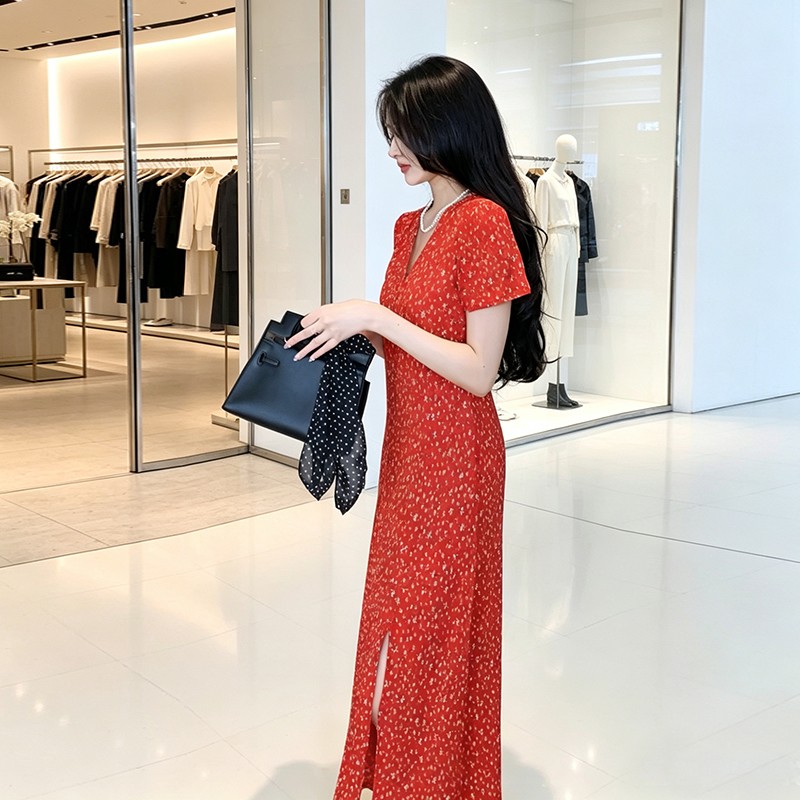
Wear a qipao as a midi-length layering piece under a cardigan or over a slim turtleneck. The collar still reads at the neckline, but the overall effect is mixed — East and West meeting naturally rather than as a statement. If you prefer a less structured collar, the floral V-neck midi dress with side slit borrows the qipao’s slit and fitted line while offering a more relaxed neckline.
3. What Is the Evening Version of Qipao Styling?
Short answer: Wear a qipao in a bold color with minimal jewelry. The silhouette is already the statement, so you do not need to pile on accessories — add a simple clutch, one pair of earrings, and shoes with a clean line. It stands out at an event without the formality of a ballgown.
For events where you want to stand out without wearing a ballgown, a qipao in a bold color with minimal jewelry does extraordinary work. The silhouette is already the statement — you do not need to pile on accessories. Add a simple clutch, one pair of earrings, and shoes with a clean line.
What Occasions Is a Qipao Suitable For?
Short answer: More than most people assume. The modern qipao fits cultural celebrations such as Lunar New Year and weddings, creative workplaces including design studios and galleries, dinner parties, gallery openings, and travel in Asia, where wearing one in Shanghai, Hong Kong, or Taipei connects you to the local visual language.
The modern qipao fits more settings than most people assume:
- Cultural celebrations — Lunar New Year, weddings, family gatherings where the garment carries meaning
- Creative workplaces — design studios, galleries, fashion offices where personal expression is welcome
- Dinner parties — the fitted silhouette and unique neckline make you memorable without excess effort
- Travel in Asia — wearing a qipao in Shanghai, Hong Kong, or Taipei connects you to the local visual language respectfully
- Gallery openings and cultural events — the garment’s own artistry matches the setting
What Accessories Should You Wear With a Qipao?
Short answer: Keep it minimal, because the neckline and closure are already ornamental. Choose one focal jewelry piece — earrings or a bracelet, not both — wear your hair up or pulled back so the neckline stays visible, and finish with clean-lined shoes and a small structured bag.
The qipao’s neckline and closure are already ornamental. Over-accessorizing competes with the garment’s own design. Follow these principles:
- Jewelry: One focal piece — either earrings or a bracelet, not both. Studs or small drops complement the mandarin collar without crowding it.
- Hair: The collar works best with hair up or pulled back — a low bun, a sleek ponytail, or a half-up style that leaves the neckline visible.
- Shoes: Clean lines. Pointed-toe pumps, minimal sandals, or even well-chosen flats. Avoid heavy platforms that clash with the qipao’s elegance.
- Bags: Small and structured. A clutch or a rigid mini-bag. Oversized totes imbalance the qipao’s precise proportions.
What Fabric Should a Modern Qipao Be Made Of?
Short answer: Four options prioritize wearability over traditional silk brocade. Cotton blends are breathable and easy to wash, linen blends are slightly more structured with natural texture, lightweight rayon gives drape and print clarity, and silk-cotton blends combine silk’s luxury feel with cotton’s easier care.
Traditional qipaos used silk brocade — stunning, but heavy and high-maintenance. Modern options prioritize wearability:
- Cotton blends — breathable, easy to wash, perfect for casual and warm-weather wear
- Linen blends — slightly more structured than cotton, with natural texture that reads as elevated
- Lightweight rayon — drape and print clarity; ideal for floral or polka-dot patterns
- Silk-cotton blends — the luxury feel of silk with cotton’s easier care
Is the Qipao Still Relevant Today?
Short answer: Yes. The qipao is not a museum piece frozen in one era — it is a silhouette that has been reinvented for over a century and continues to evolve. Wear it your way: paired with sneakers for a market morning, layered under a cardigan for the office, or worn solo for a distinctive evening.
It is not a museum piece frozen in one era — it is a silhouette that has been reinvented for over a century and continues to evolve. The modern qipao asks you to wear it your way: paired with sneakers for a market morning, layered under a cardigan for the office, or worn solo for an evening that calls for something distinctive. ZhiMo Trading’s factory-direct pricing means you can own a qipao without treating it as a precious investment — wear it, wash it, and let it become part of your everyday rotation.
Frequently Asked Questions About the Modern Qipao
What is the difference between a qipao and a cheongsam?
They are two names for the same garment. Qipao and cheongsam both describe the single-piece dress that replaced the two-part robe-and-skirt tradition in 1920s Shanghai, and modern versions keep the mandarin collar and the side slits while loosening the fit.
Can you wear a qipao to work?
Yes, if you choose the right version. A short-sleeve qipao with low block heels and a structured tote reads as polished office wear, especially in a print such as polka dots or abstract florals rather than traditional brocade. It suits creative workplaces such as design studios, galleries, and fashion offices best.
What jewelry goes with a qipao?
One focal piece — either earrings or a bracelet, not both. Studs or small drops complement the mandarin collar without crowding it. Because the collar and the front closure are already ornamental, a single pair of earrings plus a simple clutch is usually enough.
What shoes should you wear with a qipao?
Shoes with clean lines: pointed-toe pumps, minimal sandals, or well-chosen flats. Avoid heavy platforms, which clash with the qipao’s elegance. For a more casual look, sneakers work for a market morning, while low block heels keep the silhouette formal enough for an office or a dinner party.
Is a qipao comfortable in summer?
It can be, depending on the fabric. Cotton blends are breathable and easy to wash, linen blends add natural texture, and lightweight rayon gives good drape for floral or polka-dot prints. Those three work better in heat than traditional silk brocade, which is heavy and high-maintenance.
How should you wear your hair with a qipao?
Up or pulled back, because the mandarin collar works best when the neckline stays visible. A low bun, a sleek ponytail, or a half-up style all leave the collar clear. Wearing it down tends to cover the neckline, which is one of the garment’s defining features.